Commercial projects and long-running job sites across Nashville rely on routine tank evacuations to prevent capacity failures and odor complaints. A standard 60-gallon portable toilet reservoir supports 10 workers over…
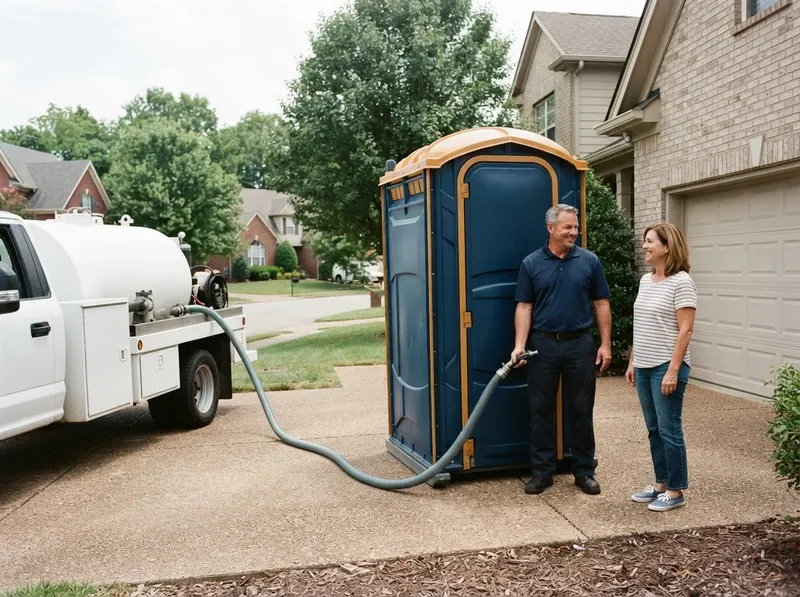
Commercial projects and long-running job sites across Nashville rely on routine tank evacuations to prevent capacity failures and odor complaints. A standard 60-gallon portable toilet reservoir supports 10 workers over an average 40-hour work week before requiring waste evacuation under OSHA standard 29 CFR 1926.51. When site volume increases, choosing a weekly route avoids tank displacement overflow, whereas bi-weekly servicing suits low-traffic staging areas. The primary operational trade-off centers on service frequency versus staging space: smaller footprint units require recurring weekly visits, while higher-volume external holding tanks (250 to 500 gallons) reduce pump truck visits but consume valuable laydown space on compact construction footprints.
Servicing equipment in tight Nashville neighborhoods demands exact logistical coordination. Vacuum pump trucks carry 30-foot to 50-foot intake hoses that require clear physical approach paths free of overhead low-hanging utility lines or parked vehicles. In high-density infill zones like Germantown, The Gulch, and 12 South, alleys and shared utility easements require narrow-chassis pump trucks to reach ground-level units without blocking residential through-traffic. On steep residential job sites common to Sylvan Park, Bellevue, and Green Hills, vacuum extraction must occur on stable grades where service technicians can lock out suction valves safely without spillover risks. Heavy industrial yards in Antioch and riverfront staging areas in Donelson and Wedgewood-Houston demand high-capacity evacuations matched with physical proof-of-service tags secured to every unit.
Executing a proper pump-out involves a 4-step maintenance cycle. First, a technician couples an airtight 3-inch vacuum hose to the unit reservoir, evacuating solid and liquid waste directly into a sealed transport tank. Second, technicians pressure-rinse the tank walls to clear residual wall scale and prevent anaerobic bacteria growth. Third, the holding chamber receives a fresh 5-gallon recharge of biocidal blue deodorizer, breaking down organics between service intervals. Fourth, the technician refills hand sanitizer dispensers, stocks two-ply toilet paper, and dates the physical inspection log inside the door. Units failing regular vacuum cycles risk toxic methane venting and sediment compaction, which can permanently damage poly-plastic tank seals and require complete unit replacements.
Every job gets a firm, written price after a free on-site visit.
Tell us about your scheduled tank pump-out service job in Nashville and we'll send a clear, written quote, usually the same day.
 Prairie Dog Portable Toilets