Federal Title III compliance requires at least 5% of total event or job site restrooms, and no fewer than one unit per sanitation cluster, to meet Americans with Disabilities Act standards. An ADA accessible portable…
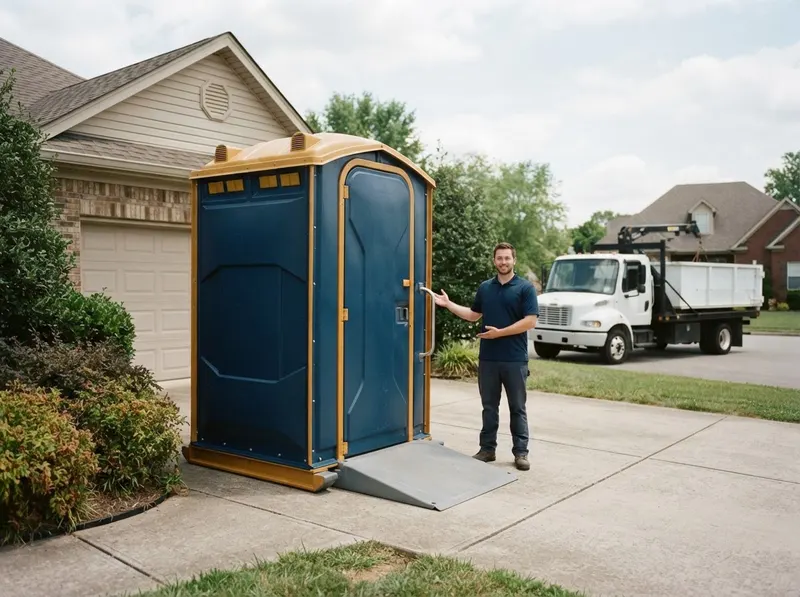
Federal Title III compliance requires at least 5% of total event or job site restrooms, and no fewer than one unit per sanitation cluster, to meet Americans with Disabilities Act standards. An ADA accessible portable toilet differs sharply from a standard unit: it features an oversized 90-by-90-inch exterior footprint, a direct roll-in threshold with zero step, magnetic or easy-latch closures operable with a closed fist under five pounds of force, and interior handrails mounted at 33 to 36 inches above the finished floor. While standard compact units serve general job site needs, selecting an ADA unit prevents civil rights compliance violations, keeps Metro Nashville Department of Codes and Building Safety permits valid, and guarantees barrier-free dignity for attendees in crowded corridors from The Gulch to Germantown. The operational trade-off is footprint: ADA units require double the exterior clearance of basic units, meaning tight infill alleys in 12 South or Wedgewood-Houston must have a cleared, level path at least 48 inches wide for hand-truck cartage.
Site staging across Middle Tennessee presents distinct topography that can impact accessibility. Setting up an ADA unit on steep clay inclines in Bellevue or unpaved event lawns near Shelby Bottoms Greenway in East Nashville demands solid, level placement to maintain a ground slope under 1:48 (roughly 2%). If a service pad slopes beyond this grade, wheelchair stability fails and the exterior door swings shut against the user. Technicians stake and shim units securely on stabilized ground, ensuring the zero-threshold ramp meets packed stone, asphalt, or concrete flush without creating an illegal lip over one-half inch. For commercial infrastructure upgrades along Donelson Pike or retail renovations in Green Hills, placing these units ensures full accessibility without blocking active construction staging zones.
Every long-term or weekend ADA rental follows an objective three-step placement process. Step 1 is the physical site assessment: confirming a continuous, firm route from the primary site entrance to the stall without curbs, mud ruts, or drop-offs. Step 2 is the stabilized drop: anchoring the unit against high-wind corridors near open river basins or highway margins in Antioch, verifying interior grab bars hold standard 250-pound shear loads. Step 3 is the verified maintenance cycle: running a bi-weekly or weekly 30-point sanitization protocol that empties the low-profile holding tank via sealed vacuum lines, replenishes hospital-grade surface sanitizers, recharges blue non-formaldehyde odor counter-agents, and logs the service date directly on the internal manifest.
Every job gets a firm, written price after a free on-site visit.
Tell us about your ada accessible portable toilet job in Nashville and we'll send a clear, written quote, usually the same day.
 Prairie Dog Portable Toilets